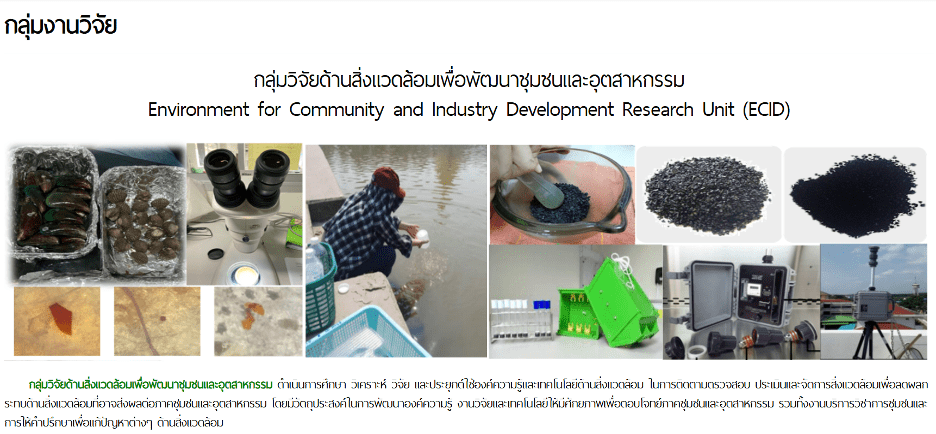
KMUTNB, through its Faculty of Science, Energy and Environment (Rayong campus), is actively advancing research and industrial engagement to protect aquatic ecosystems. Within its research unit, the Environment for Community and Industry Development Research Unit (ECID) (https://sciee.kmutnb.ac.th/res.php?r=5), the university conducts environmental monitoring and develops technological solutions focused on marine and coastal environments.
The university collaborates with industry partners and local communities to develop and implement technologies such as wastewater-and-effluent treatment systems, contaminant removal materials, and sediment remediation methods that reduce harmful inputs into marine and coastal waters. For example, the ECID group has published work on residues in mangrove surface sediments and the feasibility of phytoremediation. These efforts help ensure that industrial and community activities adjacent to the coast are more sustainable and less damaging to aquatic ecosystems.
KMUTNB also undertakes monitoring and assessment of pollutants—such as microplastics in beach sediments along the coast of Rayong Province—to establish baseline data and support intervention strategies that protect marine life and ecosystem health. By combining monitoring, applied research, and industry/community engagement, KMUTNB aims to prevent or minimise damage to aquatic ecosystems and thereby contribute to the achievement of SDG 14: conserved and sustainably used oceans, seas and marine resources.
For example:
KMUTNB’s research portfolio includes projects documented in their research database addressing direct work on technology or practices for aquatic ecosystem protection. (Source: KMUTNB Research Database)