KMUTNB is committed to reducing plastic waste generation across all campuses as part of its sustainability strategy and alignment with the United Nations Sustainable Development Goals. The university recognizes the significant environmental impacts of plastic pollution and aims to lead by example in promoting a plastic-free and environmentally conscious campus community.
1. Policy Commitment and Governance
KMUTNB has established a university-wide policy to phase out single-use plastics and promote environmentally friendly alternatives. This includes banning single-use plastic cups, straws, and bags in university canteens, convenience stores, and vending areas. A sustainability committee, under the Office of the President, oversees the implementation, monitoring, and evaluation of plastic reduction initiatives in collaboration with student organizations and campus service providers.
2. Waste Reduction and Substitution Measures
To minimize plastic waste, the university promotes the use of reusable containers, water bottles, and eco-friendly packaging through campaigns and incentives. Food vendors and campus stores are encouraged and supported to transition to biodegradable or recyclable materials. Water refill stations are installed across the campus to discourage the purchase of bottled water. Procurement policies prioritize suppliers who use minimal or recyclable packaging materials.
3. Education, Awareness, and Engagement
KMUTNB integrates plastic waste reduction awareness into environmental courses, workshops, and extracurricular activities. Students, faculty, and staff are encouraged to participate in campaigns such as “KMUTNB Plastic-Free Day” and clean-up events (https://www.green.kmutnb.ac.th/news/view?id=156) that highlight the importance of waste separation and recycling. The university also collaborates with local communities and industries to share best practices in waste management and promote circular economy approaches.
4. Waste Management and Recycling Systems
Dedicated recycling stations are strategically placed throughout the campus to encourage proper waste segregation. The university works with certified waste management companies to ensure that recyclable plastics are properly collected and processed. Regular audits of waste streams are conducted to identify key sources of plastic waste and assess progress toward reduction goals.
5. Monitoring, Reporting, and Continuous Improvement
KMUTNB continuously monitors plastic waste generation and reduction outcomes through quantitative data collection and annual sustainability reporting. Feedback from students and staff is used to refine the action plan and introduce innovative waste management solutions. The university aims to achieve a measurable reduction in plastic waste each year, with the long-term goal of becoming a single-use-plastic-free campus.
Through these coordinated actions, KMUTNB demonstrates its strong commitment to environmental stewardship, responsible resource management, and the promotion of a sustainable, waste-free learning environment.
For example:
- Graduate School Plastic Reduction Campaign (2024):
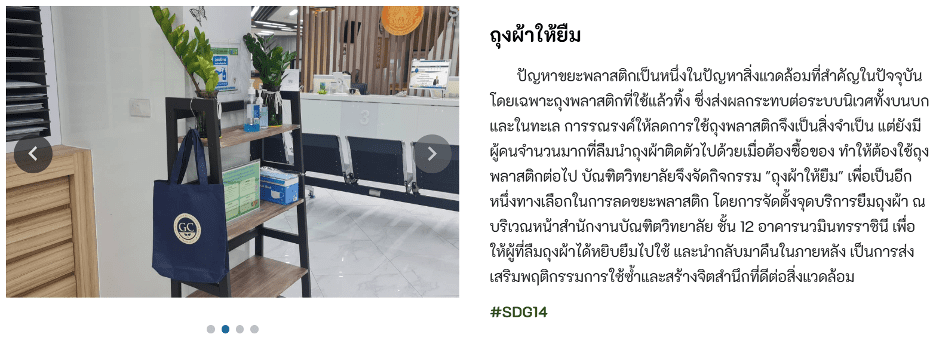
The Graduate School of KMUTNB launched the campaign as part of its SDG 14 initiative, encouraging staff and students to reduce single-use plastics by switching to reusable cloth bags and containers. The activity promotes awareness of marine pollution reduction and aligns with national plastic waste management goals.
Source: Graduate School KMUTNB SDGs Project (P-2567)
- ITED Green Office Initiative:
The Institute for Technical Education Development (ITED) implements a “Green Office Policy” promoting reduced plastic use through banning plastic cups and straws, encouraging personal tumblers, and using eco-friendly packaging during events. Source: ITED Green Office KMUTNB