KMUTNB commits to engaging with the wider community — including alumni, local residents, displaced persons, and other non‑traditional learners — through dedicated outreach educational activities aligned with the Sustainable Development Goals (SDGs). Our goal is to extend meaningful learning opportunities beyond campus, empower communities with knowledge and skills for sustainable development, and foster partnerships that enable social inclusion, environmental awareness, and sustainable livelihoods.
Community Sustainability Workshops
KMUTNB organizes short‑workshops in local neighbourhoods, community centres and for displaced or marginalised groups, focusing on themes such as clean energy, circular economy, digital literacy for sustainable development, and disaster preparedness (linked to SDG 4, 7, 11, 12, 13).
Example: Alumni and students from KMUTNB act as facilitators, providing practical sessions – for example “how to audit home energy use” or “how to design a small community recycling system” – tailored for local residents. These workshops are offered free or at very low cost, with materials developed in collaboration with NGOs or local governmental organisations to ensure accessibility and relevance.
Alumni‑led Sustainability Education Program
KMUTNB creates a programme where its alumni, especially those working in industry, environment, or community sectors, partner with the university to deliver courses or seminars for the wider public. These might include evening or weekend “Sustainability for All” modules: such as “Green Business Practices for Small Enterprises”, “Renewable Energy For Homes”, or “Data for Community Change”. Alumni serve as guest‑lecturers or mentors, share real‑world experience, and help participants (including local entrepreneurs, residents, community groups) develop sustainable‑development oriented action plans. This supports SDG 8 (Decent Work & Economic Growth), SDG 9 (Industry, Innovation & Infrastructure) and SDG 17 (Partnerships for the Goals).
Mobile Learning & Outreach Hub for Displaced or Underserved Populations
KMUTNB establishes a mobile or pop‑up learning hub (for example a bus, van, or temporary classroom) that travels to underserved areas, including displaced persons’ camps or refugee‑adjacent communities. The hub will provide short modules on technology, environment, sustainability, and self‑employability skills: e.g., basic electronics for solar lighting, micro‑entrepreneurship in green products, or digital tools for data‑monitoring community waste/energy. The curriculum is developed by the university’s faculties in science, energy & environment, and digital technology – aligning with programmes such as CIPE (Chemical Industrial Process & Environment) and ETAM (Energy Technology & Management). This activity helps address SDG 10 (Reduced Inequalities) and SDG 4 (Quality Education) by making learning accessible to broader groups.
Community Research & Co‑Creation Projects
KMUTNB invites community groups, local residents, and NGOs to collaborate in research or innovation projects that address sustainability challenges in their neighbourhoods (e.g., flood resilience, energy efficiency in low‑income housing, waste valorisation). Students and faculty will work side‑by‑side with community members to co‑design solutions, then hold public “show‑and‑tell” events to share results and promote uptake. These projects underscore experiential learning beyond campus, giving communities ownership of solutions and the university’s expertise in sustainability. Links to SDG 11 (Sustainable Cities & Communities), SDG 13 (Climate Action), SDG 17 (Partnerships for the Goals) are clear.
Public Educational Resource & Outreach Portal
KMUTNB will develop a publicly accessible online portal or app for the community that features short learning modules, video‑tutorials, community case‑studies on sustainability, and interactive quizzes or challenges. Topics might include “Home Energy Monitor”, “Community Plastic Audit”, “Digital dashboard for Local SDG Action”. The resources are freely available for alumni, residents, schools, and NGOs. In addition, the university will organise periodic community “hackathons” or “innovation challenges” where participants (including non‑students) use these resources to propose local‑solution projects, supported by mentoring from KMUTNB faculty. This helps actionable learning, social inclusion, and translates learning into community impact.
For example:
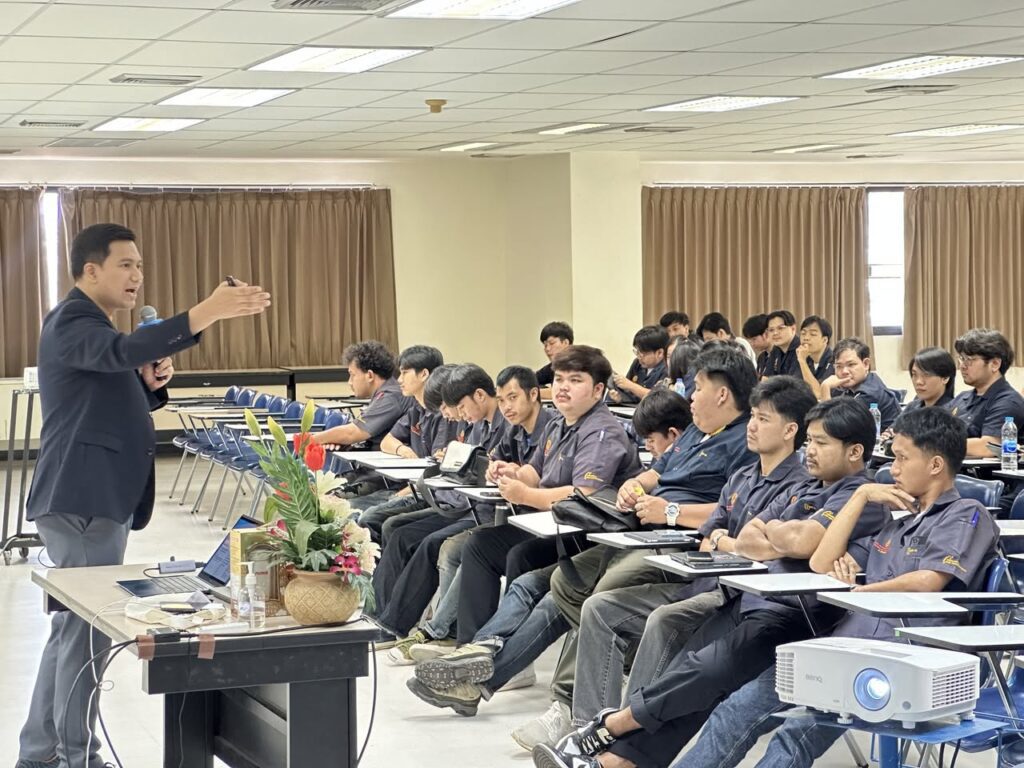
The Faculty of Industrial Technology and Management (FITM) at King Mongkut’s University of Technology North Bangkok (KMUTNB) conducted an outreach activity for the wider community, engaging local residents and stakeholders in sustainable education and awareness initiatives.
Source: FITM Facebook post