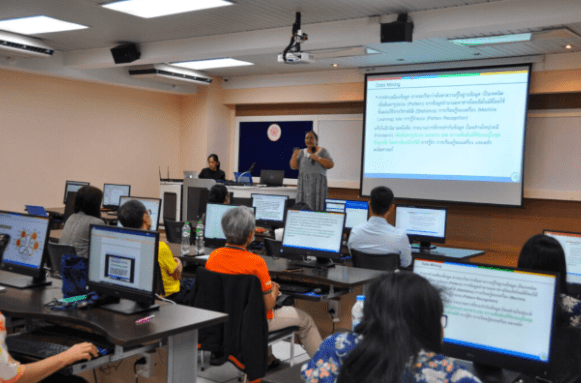
King Mongkut’s University of Technology North Bangkok (KMUTNB) is dedicated to fostering sustainable local entrepreneurship by providing comprehensive support to community-based start-ups. Through initiatives such as mentorship programmes, training workshops, and access to university facilities, KMUTNB aims to equip aspiring entrepreneurs with the necessary skills and resources to establish and grow financially and socially sustainable businesses.
In 2024, KMUTNB organized a series of community engagement activities, including workshops and consultations, to assist local entrepreneurs in developing viable business models and strategies. These efforts are part of the university’s commitment to contributing to the local economy and promoting social development through education and collaboration.
For example:
- KMUTNB Community Engagement Activities (2024). Support for local entrepreneurs through workshops and consultations.
Retrieved from: https://www.kmutnb.ac.th/news/university-news.aspx?searchtext=ชุมชน&mm=&yy=2024 - The Faculty of Architecture and Design, KMUTNB, in collaboration with Thai Beverage Public Company Limited (ThaiBev), has launched the Creative Young Designer Season 4 project. The initiative aims to enhance the image of Ban Chiang community products and local SM enterpreneurs, modernizing them to appeal to the new generation with distinctive styles. The project encourages young people to co-create innovative product designs while maintaining the community’s unique local identity. Faculty members, students, and executives from Thai Beverage visited the Ban Chiang Community Pottery and Painting Learning Center in Ban Chiang Subdistrict, Nong Han District, Udon Thani Province. They also explored ancient artifacts aged approximately 5,600–1,800 years at the Ban Chiang National Museum, a UNESCO World Heritage archaeological site. The Ban Chiang archaeological discovery revealed beautifully crafted earthenware with distinctive local designs—featuring curved lines, cord-marked patterns, spirals, and geometric motifs. Various forms of pottery were found alongside bronze and iron tools and ornaments. Ban Chiang was inscribed as a World Heritage Site in December 1992 by the United Nations Educational, Scientific and Cultural Organization (UNESCO). Archaeologists have classified Ban Chiang pottery into three periods: Early Period: 5,600–3,000 years ago, Middle Period: 3,000–2,300 years ago, Late Period: 2,300–1,800 years ago. Asst. Prof. Dr. Somjai Mahameen, Head of the Innovative Ceramic Product Design Program, Department of Industrial Education Technology, Faculty of Architecture and Design, KMUTNB, stated that the field trip allowed students to gain real-world learning experiences about world heritage art and culture, including the unique forms and patterns that represent Thailand’s national identity. Students also absorbed the community’s way of life from past to present, appreciating the value of products born from local wisdom. They met with community experts to understand local challenges and expressed their intention to help solve them. Students will apply their academic knowledge to develop the Ban Chiang pottery products, combining modern technology and innovation with traditional craftsmanship to improve production quality and standardize firing techniques. She added that this aligns with the goals of Creative Young Designer Season 4, which focuses on creativity and shared value through growth, forming a foundation for sustainable community development and building a strong, self-reliant local economy.