KMUTNB commits to delivering meaningful, inclusive, and applicable education around the Sustainable Development Goals (SDGs) for all students, regardless of discipline. Through curriculum integration, co‑curricular initiatives, service learning, and industry/community partnerships, the University will ensure that graduates are not only technically competent but also socially aware, environmentally responsible, and globally engaged. Our commitment is to embed sustainable development thinking throughout the learning experience, so that every student gains the knowledge, skills, values, and motivation to contribute to the SDGs in their future career and civic life.
1. Curriculum‑Integrated SDG Modules
- For the CIPE programme (Chemical Industrial Process & Environment) which covers environmental and industrial chemistry & process engineering, integrate mandatory “SDG‑Sustainability” modules or threads: e.g., “Clean Production & Circular Economy”, “Industrial Emissions, Waste and Resource Use”, tied to SDG 12 (Responsible Consumption and Production), SDG 13 (Climate Action), SDG 6 (Clean Water & Sanitation).
- For the ETAM programme (Energy Technology & Management) which emphasizes clean energy, energy conservation, digital management of energy systems. Integrate “Energy & Society” and “Energy Justice” components: e.g., “Renewable energy systems in developing contexts”, “Energy access and equity”, linked to SDG 7 (Affordable & Clean Energy), SDG 11 (Sustainable Cities & Communities). sciee.kmutnb.ac.th+3sciee.kmutnb.ac.th+3sciee.kmutnb.ac.th+3
- For the DTBI/related programmes (Digital Technology & Business Intelligence) integrate modules on “Data for Good: Using digital intelligence to monitor and achieve SDGs”, “Ethics, privacy and sustainability in digital business”, aligning with SDG 9 (Industry, Innovation & Infrastructure), SDG 17 (Partnerships for the Goals).
- Ensure that all students (regardless of major) complete at least one cross‑disciplinary capstone or project with SDG focus (e.g., “Design a sustainable system”, “Analyze a local community’s transition to renewable energy”, “Build a digital dashboard for SDG monitoring”).
2. Service Learning & Community Projects
- For every cohort, implement a service‑learning component where students engage in projects with community or industry partners on a real SDG challenge: for example students from ETAM working with local communities on solar‑microgrid installation; CIPE students collaborating with an NGO on industrial waste‑water treatment; DTBI students developing an app or data tool for tracking waste reduction in campus or city.
- These projects count as part of credit or co‑curricular requirement. It ensures direct engagement with local implementation of SDGs (linking theory and practice) and creates a tangible impact in the locale.
- At the end of each project, students produce a report/presentation that documents their contribution to specific SDGs, lessons learned, and recommendations.
3. Research & Innovation Hub for SDGs
- Establish a KMUTNB “SDG Innovation Hub” that connects students, faculty and external stakeholders (industry, NGOs, government) to conduct interdisciplinary research centred on SDGs. For example: ETAM faculty & students conducting research on advanced energy storage technologies for renewable energy adoption; CIPE undertaking research on green chemical processes and circular economy; DTBI exploring data‑analytics platforms for monitoring progress of SDGs in Thai industries or communities.
- Publish “Best Practice Case Studies” annually on the university website: highlight research outcomes, community engagement case studies, innovations that contribute to SDGs (e.g., reducing carbon emissions, increasing energy access, circular economy demonstrations).
- Provide seed funding or awards for student‑led “SDG innovation challenges” where teams propose solutions aligned to one or more SDGs and implement pilot tests.
4. Interdisciplinary Workshops, Seminars & Global Partnerships
- Conduct annual “KMUTNB SDG Symposium” open to all students and staff, where internal and external speakers (industry, NGOs, government, international partners) present on topics such as “Digital technologies for Sustainable Development”, “Energy transition in Southeast Asia”, “Circular economy in chemical industries”.
- Develop short courses or certificate programmes in collaboration with NGOs and international partners on SDG themes (e.g., “Sustainability in Industry”, “Smart Energy & Communities”, “Data for Development”).
- Facilitate student internships or exchange programmes with NGOs or global institutions working on SDGs (e.g., UN agencies, sustainability consultancies) to broaden global awareness and provide experiential learning.
For example:
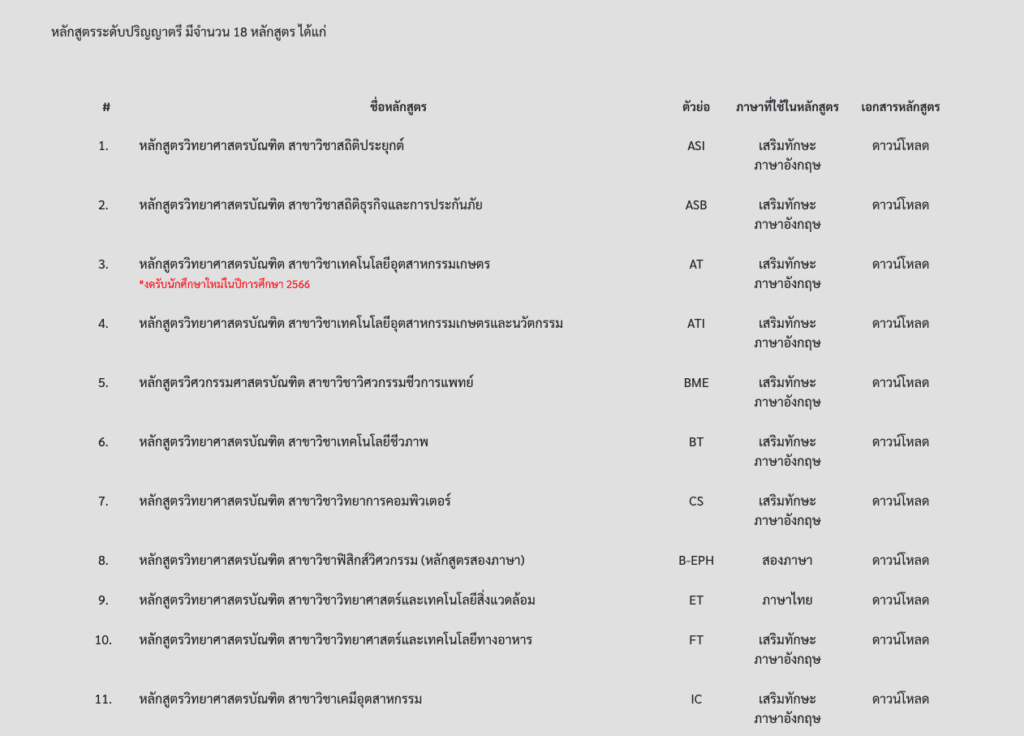
King Mongkut’s University of Technology North Bangkok (KMUTNB) is committed to providing students with relevant and practical education aligned with the Sustainable Development Goals (SDGs). The Faculty of Science and Technology offers undergraduate programs that integrate SDG-related knowledge into the curriculum, equipping students with the skills and understanding necessary to address global challenges. This includes hands-on laboratory work, research projects, and problem-solving exercises that reinforce sustainable practices and innovation. Bachelor Programs, Faculty of Science