King Mongkut’s University of Technology North Bangkok (KMUTNB) is committed to providing students with dedicated courses and learning pathways that focus specifically on sustainability and the Sustainable Development Goals (SDGs). These courses, available as full degree programs or electives, are designed to equip students with the knowledge, skills, and practical experience needed to address complex sustainability challenges in industry, society, and the environment.
Dedicated Degree Programs:
- Bachelor of Science in Chemical Industrial Process and Environment (CIPE): This program emphasizes sustainable industrial processes, environmental management, and clean technology. Students study topics such as circular economy, green chemical production, and sustainable waste management, directly addressing SDG 6 (Clean Water and Sanitation), SDG 12 (Responsible Consumption and Production), and SDG 13 (Climate Action).
- Bachelor of Science in Energy Technology and Management (ETAM): Focused on renewable energy, energy efficiency, and sustainable infrastructure, this program trains students to develop solutions for clean and accessible energy systems. Coursework covers sustainable energy policy, energy systems modeling, and climate-resilient technologies, contributing to SDG 7 (Affordable and Clean Energy), SDG 9 (Industry, Innovation, and Infrastructure), and SDG 13 (Climate Action).
Elective Courses and Cross-Disciplinary Options:
- KMUTNB offers electives across faculties that introduce students from all disciplines to sustainability concepts, such as “Sustainability in Industry”, “Environmental Policy and Governance”, “Renewable Energy Systems”, and “Data Analytics for Sustainable Development”.
- These courses integrate theoretical learning with practical projects, such as energy audits, waste reduction studies, environmental impact assessments, and digital tools for SDG monitoring, fostering real-world problem-solving skills.
Practical and Applied Learning:
- Students engage in project-based learning, internships, and research initiatives focused on SDGs. For example, ETAM students may design solar energy systems for local communities, while CIPE students develop eco-friendly chemical processes or water treatment solutions.
- Cross-disciplinary team projects allow students from engineering, technology, and business programs to collaborate on sustainability challenges, promoting SDG 17 (Partnerships for the Goals) through teamwork and knowledge exchange.
Outcomes:
- Graduates gain specialized knowledge in sustainability and applied skills to implement SDG-related solutions.
- The courses foster environmental awareness, ethical decision-making, and leadership in sustainable development across sectors.
- Students contribute directly to KMUTNB’s broader commitment to the SDGs by generating innovative solutions, engaging with communities, and advancing sustainable practices in industry and society.
For example:
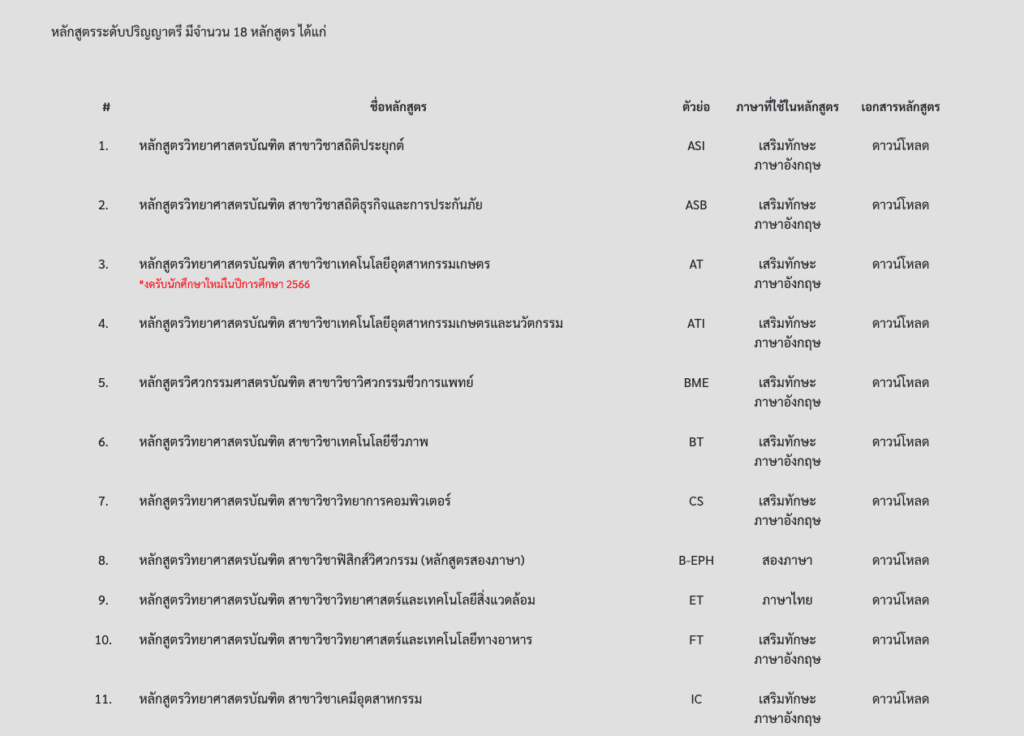
King Mongkut’s University of Technology North Bangkok (KMUTNB) is committed to providing students with relevant and practical education aligned with the Sustainable Development Goals (SDGs). The Faculty of Science and Technology offers undergraduate programs that integrate SDG-related knowledge into the curriculum, equipping students with the skills and understanding necessary to address global challenges. This includes hands-on laboratory work, research projects, and problem-solving exercises that reinforce sustainable practices and innovation. Bachelor Programs, Faculty of Science