King Mongkut’s University of Technology North Bangkok (KMUTNB) offers educational programmes and outreach activities to promote sustainable management of fisheries, aquaculture, and tourism. Through its Bachelor of Science in Environmental Technology programme, the university integrates classroom learning with field experiences to help students and local stakeholders understand the interconnections between aquatic ecosystems, resource management, and sustainable livelihoods. Building upon this academic foundation, KMUTNB organizes community workshops and outreach events aimed at promoting environmental stewardship and sustainable economic development in local and national contexts. Through its Faculty of Science, Energy, and Environment and its Rayong Campus, conducts educational outreach programmes aimed at raising awareness among local and national communities about overfishing, illegal, unreported, and unregulated (IUU) fishing, as well as destructive fishing practices. These programmes include community workshops, youth education campaigns, and collaborative projects with local fisheries offices, fishing cooperatives, and marine conservation agencies. Participants learn about the ecological and economic impacts of unsustainable fishing, national fisheries regulations, and community-based monitoring systems that help prevent IUU activities. KMUTNB also integrates practical demonstrations and participatory learning—such as sustainable aquaculture models and low-energy hatchery systems—to showcase alternatives that support both marine conservation and local livelihoods.
One key initiative is the Community Workshop on Sustainable Aquaculture and Inland Fisheries, conducted in collaboration with local administrative organizations, fisheries agencies, and community cooperatives. The workshop provides participants with practical training on best practices for freshwater aquaculture, including feed efficiency, water quality management, and eco-friendly pond design. It also introduces methods for integrating aquaculture operations with community-based tourism, helping participants understand how sustainable fish farming can contribute to both food security and local income generation. Through interactive sessions and demonstrations, participants learn to monitor water parameters, apply sustainable harvesting techniques, and design small-scale pilot projects that promote both productivity and environmental responsibility.
In addition, KMUTNB conducts the “Blue and Green Tourism” Outreach Programme, which focuses on promoting sustainable use of lakes, rivers, and coastal resources among local tourism operators, schools, and community groups. The programme offers training on minimizing ecological impacts from tourism, conserving aquatic habitats such as mangroves and wetlands, and developing educational experiences that raise visitor awareness about aquatic biodiversity and conservation. Students and community participants work together to conduct ecosystem surveys and co-develop eco-tourism models that highlight local fisheries and aquaculture as key components of regional sustainability. Through these collaborative initiatives, KMUTNB fosters long-term partnerships with local communities, strengthens environmental education, and contributes to the responsible management of aquatic ecosystems aligned with the UN Sustainable Development Goals.
For example:
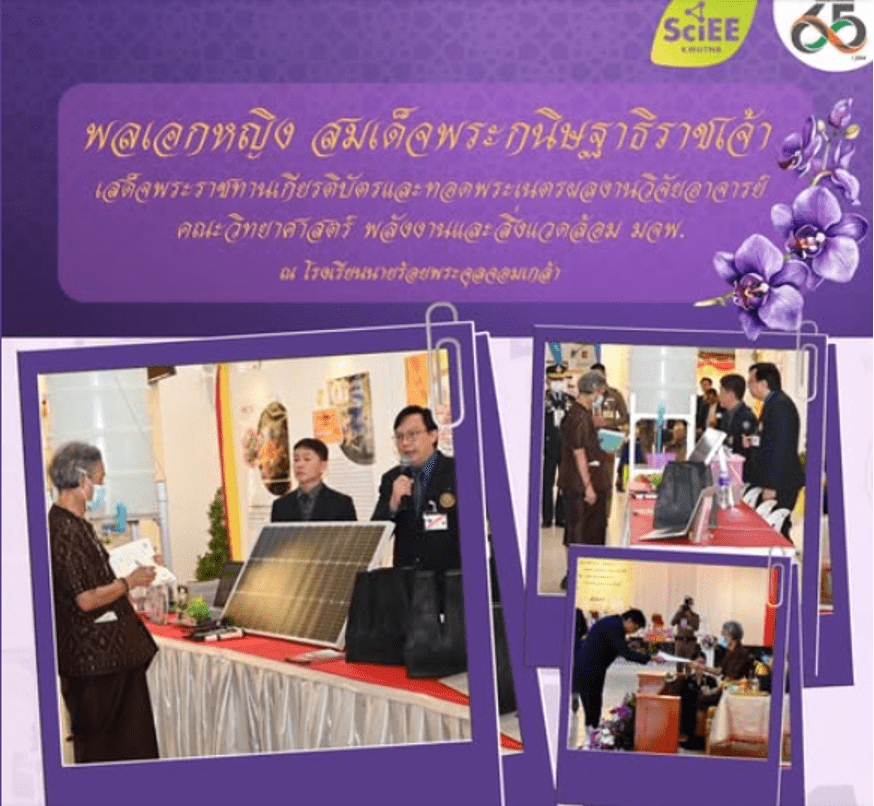
Her Royal Highness Princess Maha Chakri Sirindhorn, The Princess Royal, graciously presented certificates of honor at the “Chulachomklao Royal Military Academy Academic Exhibition 2024” and visited the research and invention exhibition displayed by King Mongkut’s University of Technology North Bangkok (KMUTNB). During the event, Assistant Professor Dr. Nattadethathorn Puangnguenmak and Assistant Professor Dr. Prayut Chiamrithiwong, lecturers from the Department of Energy Technology and Management, Faculty of Science, Energy, and Environment, KMUTNB Rayong Campus, had the great honor of presenting their research project to Her Royal Highness. Their research, titled “Low-Energy Blue Swimming Crab Hatchery System Using Natural Egg Stripping,” was conducted through collaboration among the Faculty of Science, Energy, and Environment, the Rayong Provincial Office of Agriculture and Cooperatives, the Rayong Provincial Fisheries Office, and the Rayong Fisheries Research and Development Center.